New York State’s landfill problem.
by CHRIS POLANSKY / Dec. 2019
This feature was part of an investigative reporting project that appeared in the NYCity News Service and served as a master’s capstone for the Craig Newmark Graduate School of Journalism at the City University of New York MA program under advisers Andrew Lehren and Benjamin Lesser.
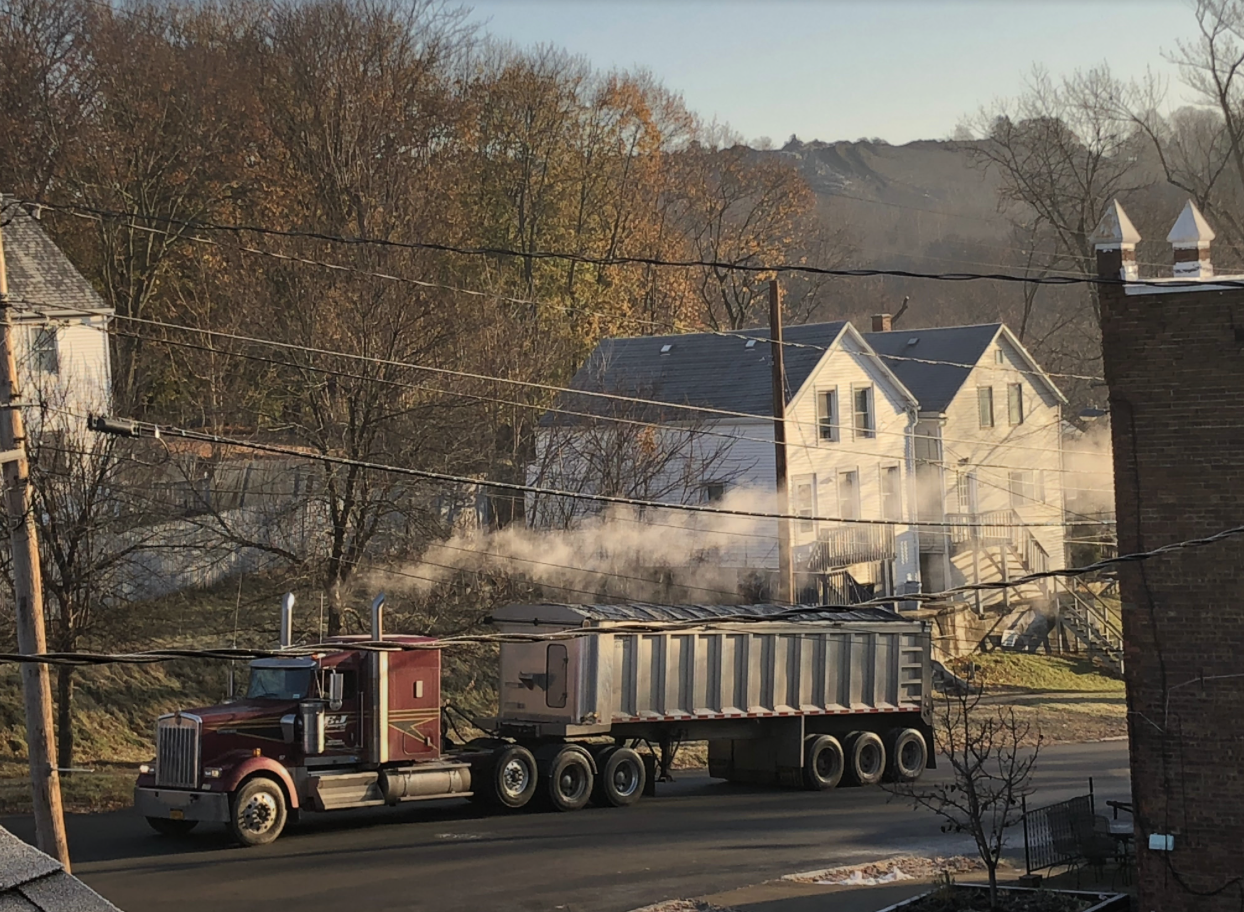
A truck driving west on Partition Street in Rensselaer, leaving the Dunn landfill (visible in background). Photo: Chris Polansky.
Andrew Kretzschmar is worried about school. That’s not unusual for a high school senior. But his main concern isn’t AP tests or college essays – it’s his health, and whether the air in and around his school is making him sick.
“You go to school, you smell the hydrogen sulfide, you smell the rotten eggs,” Kretzschmar, 17, said. “It makes an uncomfortable learning experience.”
Kretzschmar goes to the only public high school in Rensselaer, New York, a small city of about 10,000 in New York’s Capital Region, directly across the Hudson River from the state capital of Albany. The high school is part of a campus where all of Rensselaer’s K-12 public school students attend, about a thousand kids altogether.
But the most remarkable thing about the campus isn’t on school property – it’s right next to it. Just southwest of school grounds sits the massive S.A. Dunn construction and demolition debris landfill. It started operating in 2015. At 99 acres, it’s the largest of its kind in the state. Kretzschmar says the smells and dust from the dump blow over into the school just about every day, and he and his parents suspect it’s making it hard for him to breathe.
“I take my inhaler most every single day,” Kretzschmar said. “I haven’t done that since I was a little kid. I thought my asthma was getting better, but it’s worsening.”
When the New York State Department of Environmental Conservation (DEC) approved the landfill in 2012, the site’s environmental impact statement included rebuttals from the landfill operator to numerous public comments and concerns. DEC defended the landfill saying in a statement that it “is not anticipated to have adverse health effects to the surrounding community.” Yet the landfill was cited with a violation in 2018 for its inability to manage dust and hydrogen sulfide emissions coming from the site and was charged a $35,000 fine by DEC.
According to the CDC, at certain levels, chronic exposure to hydrogen sulfide can cause “low blood pressure, headache, nausea, loss of appetite, weight loss, ataxia, eye-membrane inflammation, and chronic cough” in children.
On a November evening, the gym of the town’s Boys and Girls Club hosted a public meeting of the Rensselaer Environmental Coalition, a group that formed in opposition to the landfill. About 100 people gathered at long tables to hear from Dr. Ward Stone, a retired DEC scientist.
“Your kids are smelling bad smells,” Stone said. “You know they’re taking in hydrogen sulfide. And what else? What’s in the dust that blows off of there? It is possible that what a child is exposed to now will be a problem for that child in 30 or 40 or 50 years. Now, if my kids were going to this school, I would decide that they shouldn’t be going to that school.”
Joseph Kardash, the school’s superintendent, said his students don’t need the $125,000 the landfill donates each year, either.
“That’s not a decision factor,” Kardash said. “The school is there, it’s our job to educate kids and keep them safe. If they close the dump, it certainly doesn’t hurt the school. I’ll throw the party.”
In response to concerns about hydrogen sulfide in the air around the landfill -- a smell described as rotten eggs, produced by decomposing gypsum drywall -- the DEC installed four monitors around the school property. The results, posted publicly on the school district’s website, show numerous occasions of hydrogen sulfide levels exceeding levels considered acceptable by New York State.
The levels were especially high in the month of July, with one reading coming close to 70 parts per billion -- the DEC’s acceptable standard is 10 parts per billion. The New York Department of Health acknowledges unpleasant odors are detectable to individuals at 0.5 parts per billion, and that there is “limited information on the effects of long-term exposure to low levels of hydrogen sulfide.”
The DEC actively monitors these results and works to correct elevated hydrogen sulfide emissions to ensure that the public health and environment are protected, according to the agency.
The effort to get the landfill closed has a strong ally in Judith Enck. She was in charge of the Environmental Protection Agency’s Region 2, which includes New York and New Jersey, for almost the entire Obama presidency. Before that, she worked for two New York governors, overseeing environmental policy.
“This is environmental regulation 101,” Enck said. “ If you cannot regulate a large construction/demolition debris in a residential neighborhood next to a school, you’re incapable of regulating almost anything. How did the administration of Andrew Cuomo think that this was not going to face problems and it would not affect the health of residents and school kids?”
Enck says DEC is operating in bad faith when they declare the landfill is completely safe, and that it’s no coincidence that the landfill was approved in a town like Rensselaer, a working class town where about half of the population receives some sort of public assistance.
“If this was Scarsdale, or Mamaroneck, or Bedford Hills, you never would have seen this regulatory failure that the people of Rensselaer are dealing with,” Enck said.
The landfill’s problems span beyond the school to the entire community. The landfill’s permit allows for 100 semi-trucks to go in and out of the city on residential streets. Residents say that every weekday morning beginning around 6:30, the trucks spew dust and diesel fumes and are so loud they rattle the walls of their houses. Lou Sebesta, a retired forester with DEC, lives on Partition Street, the main truck route into and out of the landfill. From his front yard, to the west you can see the Albany skyline, to the east, the landfill.
“It’s like a war zone,” said Sebesta, yelling over the din of trucks on a late November morning.
Sebesta pointed out a number of trucks without covers, despite the landfill’s permit requiring the trucks to be covered, to prevent any dust or debris from shaking loose. He said it’s par for the course. Beyond just the loss of peace and quiet, and his health concerns, Lou’s also anxious about property values. Last year he filed a tax grievance with the city, citing the landfill odors and truck traffic. Rensselaer chopped about 20% off his property tax bill.
Despite petitions, public outcry, and countless letters to the editor in the local papers, DEC maintains that the landfill is safe, and that they’re diligent in regulating it. Boosters in Rensselaer, like the outgoing mayor, Rich Mooney, point out that the landfill brings the city close to a million dollars in revenue. But for mayor-elect Mike Stammel, a Republican who ran on a firm anti-landfill platform, it shouldn’t be about that money.
“Are you gonna put revenue ahead of public health?” Stammel said. “I don’t think that’s the way we’re supposed to work. I’m going to use every tool that I can find in order to have the DEC move in onto this and try to close it.”
Stammel pointed out that though DEC occasionally fines the landfill for some violations, that money doesn’t dissuade the landfill operator -- and it doesn’t do anything to help people in Rensselaer. “They get these minimal fees at $20,000, $15,000, that the DEC is fining this dump,” Stammel said. “Ask the people what they want, because we’re not getting any of that money, it’s going right to DEC.”
Assemblyman John McDonald, who represents the area in the State Assembly, said he’s in talks with Stammel about the landfill. “Like anything else in government,” McDonald said, “there’s room for improvement.” McDonald said he believes the DEC is acting “aggressively” against the landfill operator, while also acknowledging that, “I don’t think I could ever have total confidence in any agency.”
Stammel, who publicly opposed the opening of the landfill in 2012 as a Rensselaer County legislator, said he wants to work with state lawmakers to ensure DEC does not renew the landfill’s permit when it’s up in 2022.
But Enck is not impressed.
“Once they do issue permits, they need to show up and do their job,” she said of DEC. “They need to inspect. They need to do far more sampling and monitoring. They also need to talk to the public.”